Euclid Space Telescope Captures Most Detailed Photo Ever of Milky Way's Heart
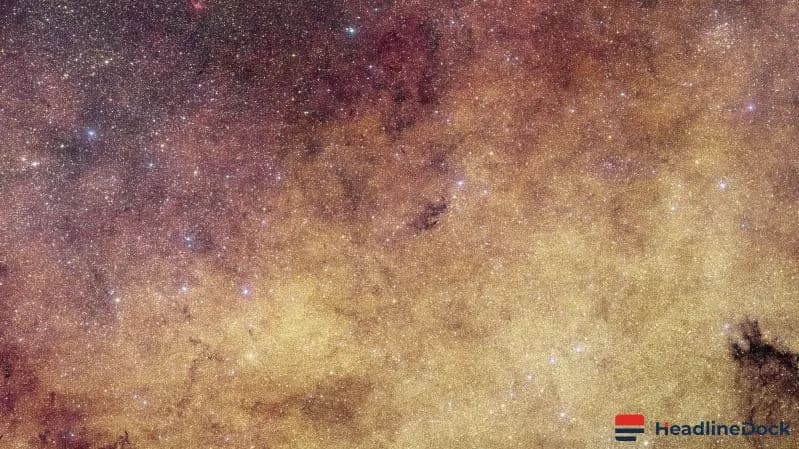
The Euclid space telescope has captured the most detailed image of the Milky Way's heart to date. This 60-million-star mosaic provides astronomers with a powerful tool to study exoplanets using the microlensing technique while advancing research into dark matter and dark energy.
Highlights
- •The Euclid space telescope captured the most detailed image yet of the Milky Way's center.
- •The photograph reveals approximately 60 million individual stars in high resolution.
- •Scientists will use the microlensing technique to discover and track new exoplanets.
- •The mission aims to study the roles of dark matter and dark energy in the cosmos.
The Euclid space telescope has achieved a major milestone in deep space observation by capturing the most expansive and intricate image ever recorded of the Milky Way's central region. This unprecedented photographic achievement, released by the European Space Agency (ESA), features a staggering array of approximately 60 million individual stars, offering a clearer view into the heart of our galaxy than ever before.
The Euclid space telescope was launched in 2023 with the primary scientific objective of mapping roughly one-third of the celestial sphere. Its ultimate goal is to provide researchers with critical data to help demystify the roles of dark matter and dark energy in the cosmos. By training its sophisticated instruments on the galaxy's most luminous section, the mission has proven its immense capabilities.
Revolutionizing Exoplanet Research
Beyond producing a breathtaking visual mosaic, the Euclid space telescope serves as a vital tool for the scientific community, particularly in the study of exoplanets—planets existing outside our own Solar System. The high-resolution data contained within this image will allow astronomers to refine their calculations regarding the mass of previously identified planets and those slated for future discovery.
The telescope utilizes a sophisticated technique known as microlensing to conduct these observations. This phenomenon occurs when a foreground star aligns perfectly with a background star, causing the closer star to act as a cosmic magnifying glass. This alignment bends and amplifies the light emitted by the more distant star. If an exoplanet is orbiting the foreground star, its gravitational pull causes further minute, detectable changes in the light's brightness, enabling scientists to locate and track these distant worlds.
The image, which took 26 hours of continuous exposure in March 2025 to capture, highlights the potential for future breakthroughs. According to experts working with the European Space Agency, the new visual data already confirms the presence of 51 known planetary systems within the field of view. By observing these systems, researchers expect to uncover many more celestial bodies in the coming years. Positioned 1.5 million kilometers away from Earth, the telescope is successfully navigating the challenges of deep space, confirming that it is an extraordinary asset in our ongoing quest to understand the universe and the planets that inhabit it.