MeerKAT Telescope Detects Record-Breaking Cosmic Signal From The Early Universe
Astronomers have utilized the South African MeerKAT telescope to identify a record-breaking hydroxyl megamaser 8 billion light-years away. This discovery provides critical insights into galaxy mergers and the conditions of the early universe during its chaotic developmental stages.
Highlights
- •The MeerKAT telescope detected the most distant hydroxyl megamaser, situated 8 billion light-years away.
- •A hydroxyl megamaser is a natural cosmic laser millions of times more powerful than standard masers.
- •Gravitational lensing and advanced data processing were essential for identifying this faint, ancient signal.
- •The finding offers new insights into galaxy mergers and the evolution of supermassive black holes.
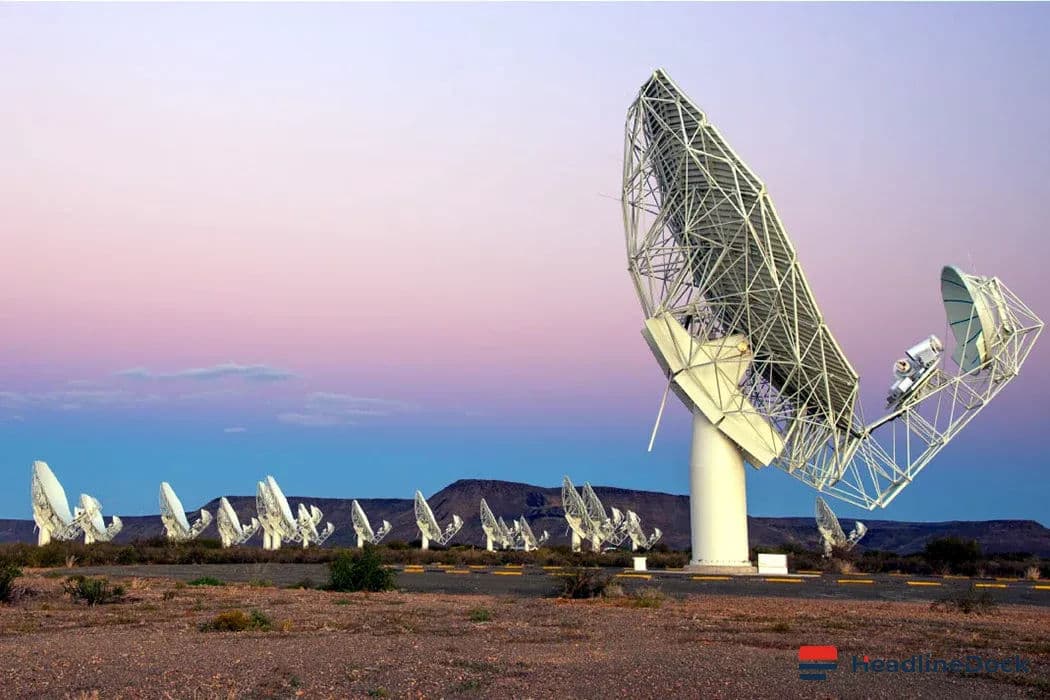
Astronomers utilizing the MeerKAT radio telescope located in South Africa have achieved a significant breakthrough in deep space exploration. The team successfully detected a record-breaking signal from the early universe, specifically identifying the most distant hydroxyl megamaser ever observed. This discovery provides researchers with a rare window into the chaotic environment of the cosmos as it existed approximately 8 billion years ago, when the universe was less than half its current age.
A hydroxyl megamaser acts as a natural space laser, emitting radio waves at a power level millions of times greater than typical galactic masers. Finding this specific object at such an extreme distance—over 8 billion light-years away—is a major milestone in radio astronomy. At that point in cosmic history, galaxies were frequently colliding, creating high-energy environments for intense star formation that differ significantly from the more stable, mature structures observed in the modern local universe.
Advanced Technology Driving Cosmic Discoveries
The ability to detect such faint signals is largely credited to the high sensitivity and expansive frequency coverage of the MeerKAT telescope. By utilizing its wide bandwidth, researchers were able to capture both the hydroxyl line and neutral hydrogen absorption within a single observation window, a task that would have required multiple separate efforts with older technology. Furthermore, the detection was boosted by gravitational lensing, where a massive foreground object acted as a natural telescope to amplify the signal from the distant source.
Beyond the hardware, the process relied on sophisticated data-intensive computing. The massive datasets generated by the telescope were processed through high-performance resources at the Inter-University Institute for Data Intensive Astronomy (IDIA). This digital refinement, involving trillions of complex calculations, successfully removed interference to reveal the signal hidden within the cosmic noise.
The study of such systems is crucial for understanding how the largest structures in the cosmos develop. These hydroxyl megamasers are typically associated with galaxy mergers, where supermassive black holes at the centers of these systems may eventually spiral toward one another. By analyzing these environments, scientists can better track the final evolutionary stages of massive galaxies before they release powerful bursts of energy. This discovery suggests that future surveys, including those planned for the upcoming Square Kilometre Array (SKA) and the next-generation Very Large Array (ngVLA), will likely uncover many more of these distant, extreme objects, fundamentally changing how we study the early history of the universe.