Beyond the Simple Virus: How Phages Communicate and Make Collective Decisions
Recent research reveals that bacteriophages use a chemical signaling system called arbitrium to communicate, allowing them to make collective decisions regarding host infection. This discovery challenges traditional views of viruses and offers promising new implications for phage therapy against antibiotic-resistant bacteria.
Highlights
- •Viruses like bacteriophages communicate using a chemical signaling system known as arbitrium to make collective decisions.
- •The arbitrium system allows viruses to assess host population density and decide between lytic or lysogenic infection cycles.
- •Communication can cross species boundaries, enabling different types of viruses to coordinate actions in the same environment.
- •These findings provide new avenues for advancing phage therapy to treat antibiotic-resistant bacterial infections.
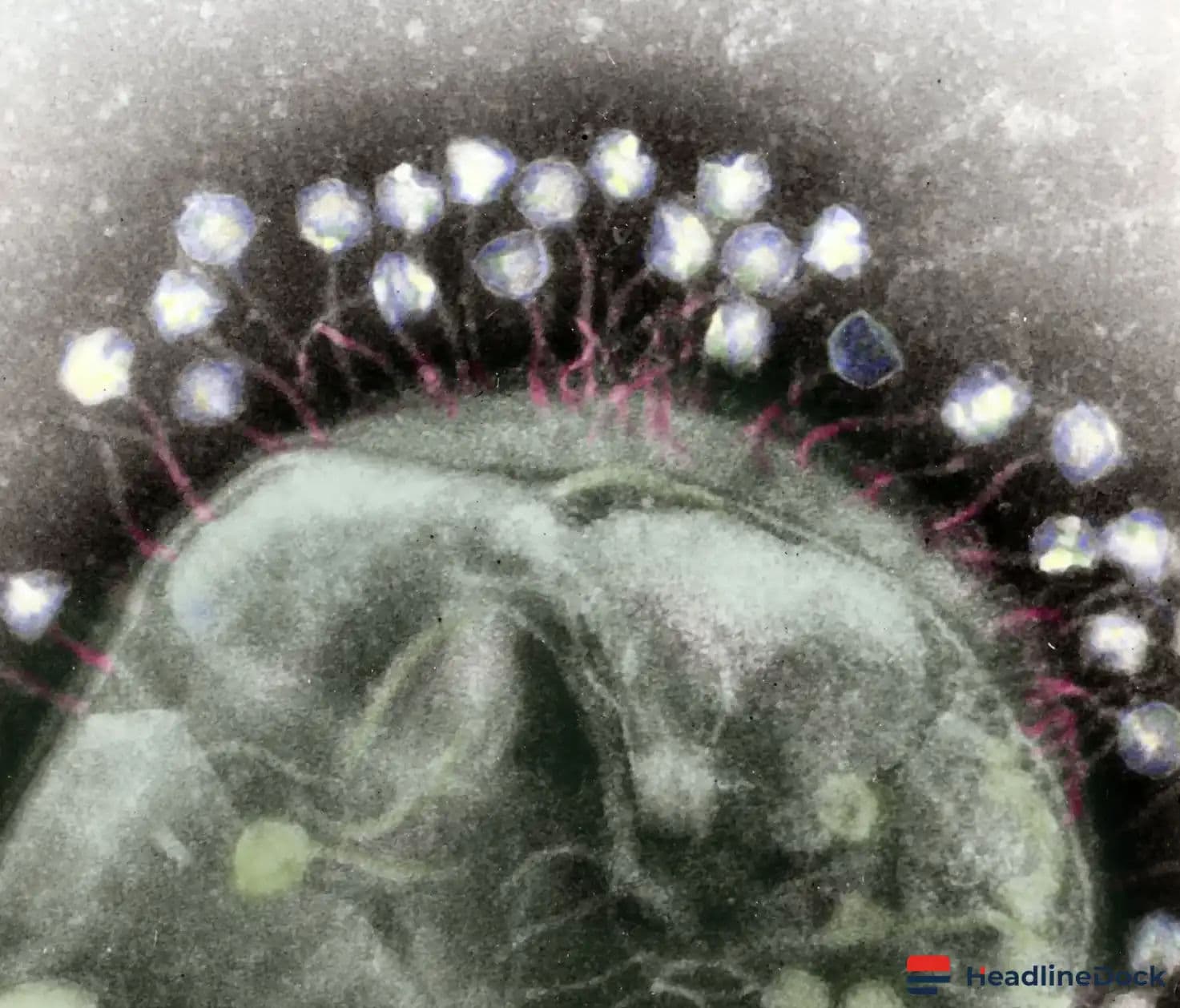
For a long time, the scientific consensus viewed viruses as simple, inert, and selfish entities. They were typically dismissed as passive particles that only demonstrated activity when invading a host cell, where they would hijack cellular machinery to replicate before ultimately destroying the host. However, recent evidence is challenging this outdated perspective, revealing that bacteriophages—viruses that specifically infect bacteria—possess surprising social and decision-making capabilities.
The Complex Social Behavior of Bacteriophages
Studies have now confirmed that these viruses do not always act autonomously or automatically. Instead, they demonstrate a capacity for collective decision-making, which can even occur between different viral species infecting diverse bacteria. This discovery fundamentally shifts our understanding of viral ecology and evolution, suggesting that these entities can process information from their environment to determine their survival strategy.
The most abundant biological entities on Earth, bacteriophages, exist in staggering numbers—estimated at 10³¹ particles throughout the biosphere. When a virus infects a host, it generally chooses between two paths: the lytic cycle, where it rapidly multiplies and destroys the host, or the lysogenic cycle, where the viral genome integrates into the host, remaining latent for generations. Previously, this choice was thought to be driven purely by chance or the internal state of the bacteria. It is now evident that viral communication through chemical signals plays a critical role in this decision.
Decoding the Language of Viral Communication
In 2017, researchers identified a molecular system called arbitrium, which acts as a form of "language" for these viruses. Upon infecting a host, a phage triggers the production of a specific peptide that is released into the surrounding environment. As infections mount, the concentration of this peptide rises, allowing subsequent viruses to "read" the signal. By sensing these levels, the incoming bacteriophages can determine whether to continue destroying the population or shift into a latent phase to preserve their host resources.
Recent laboratory advancements have shown that this communication system is not exclusive to identical phages. Some arbitrium peptides can be recognized by related viruses that target different bacterial species. This creates sophisticated networks of viral communication, allowing phages to coordinate their actions based on the activity of competitors or cooperators within the same ecological niche. This collective behavior mirrors the quorum sensing observed in many bacteria, yet its presence in viruses remains highly unexpected.
These findings provide vital insights for medical science, particularly in developing phage therapy as a robust alternative to combat antibiotic-resistant bacteria. Understanding the sophisticated decision-making mechanisms of these viruses allows for more predictable and safer biotechnological applications, while forcing researchers to redefine what constitutes "intelligence" within the smallest scales of the biological world.