IIIT Hyderabad Study on AI Procurement Wins Best Paper at IPPN 2026
A study by IIIT Hyderabad researchers on how public procurement shapes AI governance in India won the Best Paper Award at the 2026 IPPN Conference. The research highlights how operational tender processes act as a substitute for formal AI regulation.
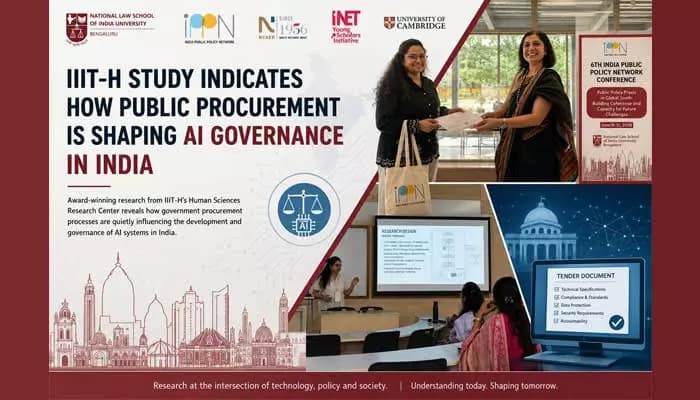
A research team from the Human Sciences Research Centre (HSRC) at IIIT Hyderabad has earned recognition for their impactful work regarding the implementation of technology policy in India. Their study, which examines how government procurement processes influence the governance and development of AI systems, was honored with the Best Paper Award in the Practice Track at the 6th India Public Policy Network (IPPN) Conference 2026.
The academic paper, titled “Emerging Institutional Pathways for AI Governance in India: Evidence from Public Procurement and Outsourcing,” highlights how the nation is currently building its oversight framework. The work was led by Prof. Aakansha Natani, alongside PhD scholar Siddhi Wadekar and dual-degree student Sujal Deoda. Held from June 8-11, 2026, the conference was hosted by the National Law School of India University (NLSIU) in partnership with prominent global and domestic research institutions, including the University of Cambridge and NCAER.
Understanding AI Governance through Procurement
The research project originated from an investigation into existing policy gaps regarding AI and data infrastructure in the country. Since India currently lacks a dedicated, standalone AI Act, the researchers sought to understand how standards are being set in the absence of comprehensive national legislation. They discovered that governance is often being shaped through operational mechanisms rather than just formal regulatory statutes.
By analyzing government tenders, technical specifications, and contractual requirements, the study revealed that public procurement is playing a critical role in defining AI governance. Because many government departments require advanced AI systems for citizen services and administration but lack in-house technical capacity, they frequently rely on private companies and startups. Consequently, the terms negotiated in these procurement contracts effectively serve as a method for setting standards, compliance requirements, and developmental expectations for artificial intelligence.
Interdisciplinary Research Approach
The success of this study is attributed to its interdisciplinary framework, which merged expertise from political science and computer science. The researchers employed a mix of computational analysis and qualitative policy review to decode the language embedded within government tender documents. This approach allowed the team to demonstrate that procurement is not merely an administrative process; it is a vital tool for policy implementation.
Ultimately, the team’s findings suggest that the future of AI governance in India will continue to be heavily influenced by the everyday processes used to commission and deploy technologies. By highlighting this trend, the IIIT Hyderabad team has provided new insights into how administrative mechanisms can fill regulatory voids, shaping the digital landscape of the nation as it continues to integrate advanced technologies across various sectors of governance.
,curated_key_highlights:[