How Corporate Seed Patents and Industry Consolidation Affect Farmers and Taxpayers
Corporate consolidation and the widespread use of seed patents have significantly impacted the agricultural sector. These practices limit independent research, increase costs for farmers, and divert taxpayer-funded subsidies toward large firms, raising major concerns about competition and long-term food security.
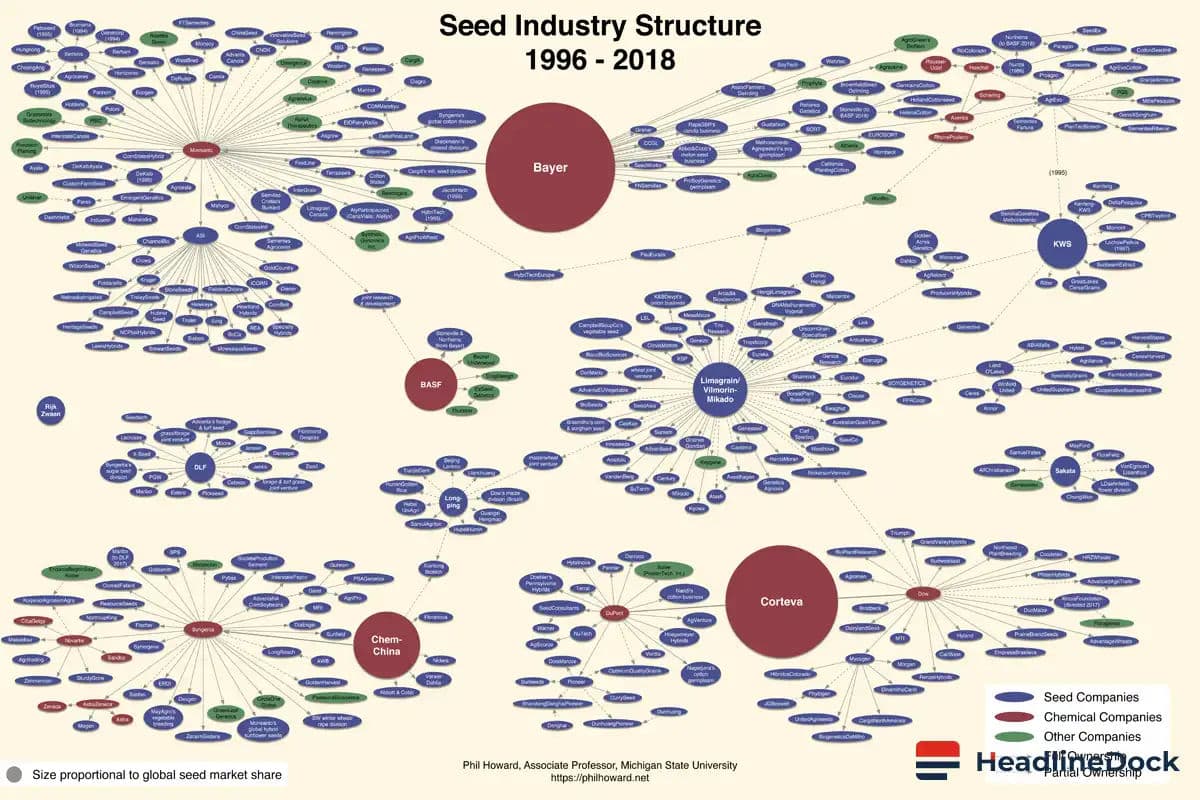
Highlights
- •Consolidation in the seed industry allows a few firms to control nearly all corn, soybean, and cotton markets.
- •Seed patents restrict farmers from saving seeds and prevent independent researchers from conducting vital genetic studies.
- •Data shows that seed prices have risen 463% since 1990, far outpacing the 56% increase in crop prices for farmers.
- •Government subsidies intended for farmers are often offset by subsequent price hikes from dominant seed-supplying corporations.
The United States is among the few nations that permit corporations to hold patents on plant varieties, a practice that critics argue stifles competition and innovation in the agriculture industry. This system often leads to a scenario where seed patents are leveraged by a handful of massive firms to dominate the market, effectively turning public taxpayer support into corporate gain.
The Impact of Seed Patents on Market Competition
Recent data from the U.S. Department of Agriculture highlights the extent of this consolidation, revealing that two major companies manage over 70% of the corn and soybean seed market. Furthermore, the top four cottonseed suppliers account for nearly 94% of the industry. This lack of diversity, according to the Department of Justice in a May 2026 court filing, serves as a significant obstacle to agricultural research and fair competition.
Historically, farming relied on a decentralized approach where seeds were shared resources saved and exchanged by growers. By the 1970s, public researchers at government institutions and universities drove most plant breeding. However, the modern shift toward patenting living organisms—which began with genetically engineered bacteria—has fundamentally changed this. Today, companies utilize seed patents to prohibit farmers from saving seeds and to restrict other scientists from performing independent breeding research.
Economic indicators suggest this has created a lopsided financial environment. Since 1990, the cost of genetically engineered seeds has surged by 463%, whereas the prices received by farmers for their harvested crops have risen by only 56%. This imbalance forces many farmers to rely on government subsidies, which often end up benefiting the seed suppliers indirectly.
How Subsidies and Consolidation Influence Farming
A notable 2025 study found that as farm subsidies rise, dominant seed firms often respond by increasing their prices based on what farmers can afford to pay, rather than reflecting production costs. For every 1% increase in subsidies, these companies have raised prices by approximately 0.5%. This cycle essentially diverts public funding away from the farmers it was intended to support.
Furthermore, the restrictive nature of these contracts prevents independent analysis. Researchers have faced threats of patent-infringement litigation for attempting to study the genetic composition of these crops. Consequently, there remains a lack of public knowledge regarding the vulnerability of key food crops to potential diseases or pests. The ongoing legal conflict between Corteva and Inari, which prompted the Department of Justice to weigh in, highlights the increasing tension over whether such expansive patent rights remain justified in the interest of public food security.