Tracing the Humble Beginnings of Soccer in 19th-Century English Boarding Schools
Soccer, today a global sporting powerhouse, began as a tool for discipline in 19th-century English boarding schools. Its transition from uncodified folk games to a structured, professional sport was solidified by the 1863 establishment of the Football Association rules in London.
Highlights
- •Soccer originated in 19th-century English boarding schools as a disciplinary tool for teachers.
- •Early 'folk football' was chaotic, unregulated, and fundamentally different from modern structured gameplay.
- •The 1863 London meeting established core rules that prohibited using hands, forming the basis of modern soccer.
- •The sport transitioned from an amateur student activity to a professional global competitive phenomenon.
While soccer is recognized today as a premier global sporting spectacle, its historical roots are surprisingly humble and local. Contrary to its current status as a massive international industry, the game originated within the elite boarding schools of 19th-century England, serving as a specific tool for educators to manage their students.
In the early 1800s, institutions such as Eton sought ways to channel the abundant energy of students from wealthy backgrounds. These youths often challenged school authority, and teachers viewed physical exertion through ballgames as an effective strategy to regain control, keep pupils occupied, and discourage behavior deemed inappropriate. Soccer effectively emerged not as a pre-planned athletic pursuit, but as a mechanism for institutional discipline.
The Evolution and Codification of Football
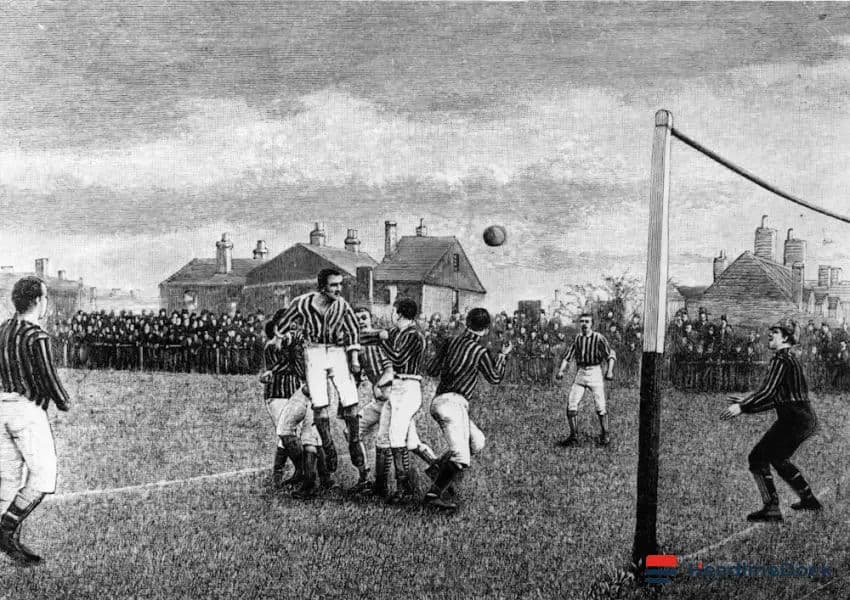
Before becoming a structured school activity, various forms of folk football existed across Britain. These early iterations were largely unregulated, involving large groups from neighboring villages attempting to move an object across a designated marker. These chaotic events bore little resemblance to the organized sport played today. As the game moved onto school grounds, it remained uncodified for decades, with rules varying wildly between institutions. At Rugby School, early versions allowed for the use of hands, while students at Eton famously developed regulations in 1847 that strictly prohibited handling the ball.
The transition toward the modern iteration of soccer gained momentum in 1863. Representatives from various football clubs in London gathered to establish a unified set of regulations. Ebenezer Cobb Morley, captain of the Barnes Football Club, was instrumental in this process. The resulting 1863 rules formally banned carrying, throwing, or picking the ball up from the ground, creating the distinct foundation for what is known today as association football.
This move toward standardization marked the maturation of the sport. As football shifted from an amateur school activity to a competitive club-based sport, the need for consistent rules became paramount. The introduction of the Football Association Challenge Cup in 1872 by Charles W. Alcock further accelerated this professionalization. What began as a means to manage energetic teenagers in boarding schools eventually transformed into the massive, highly professionalized athletic phenomenon that commands worldwide attention today.