Protest at Bundaran HI: How Citizens Are Reclaiming Their Right to the City
The recent student-led demonstration at Bundaran HI, Jakarta, has ignited a debate over the public's right to the city. By staging protests in an economic hub, activists are challenging state efforts to domesticate urban spaces and control political discourse within the capital.
Highlights
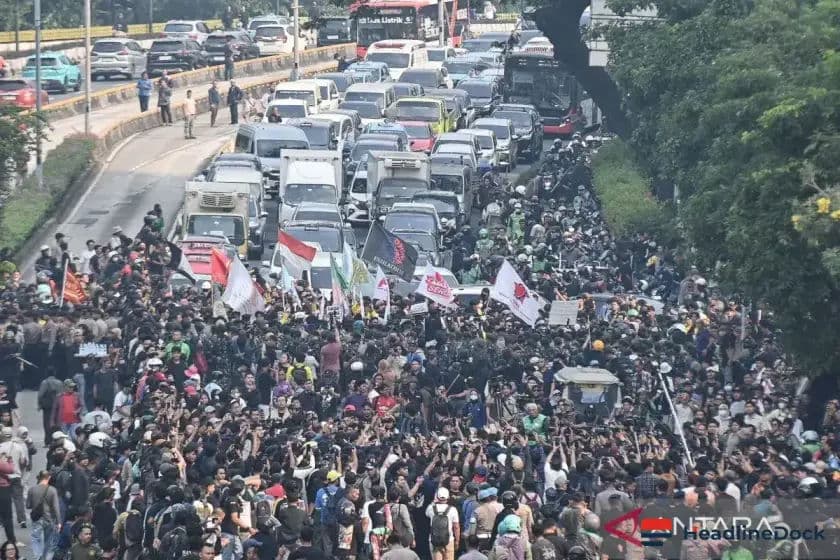
- •Students attempted to hold a demonstration at the iconic Bundaran HI, Jakarta, on June 12, 2026.
- •The protest sought to highlight economic instability by disrupting a key commercial and economic hub.
- •The action raised debates regarding the 'right to the city' and how public spaces are controlled by the state.
- •Authorities utilized barricades to restrict access, framing the area as a dedicated economic zone rather than a political forum.
The recent demonstration at Bundaran HI in Jakarta has sparked a significant conversation regarding the public's right to the city. On Friday, June 12, 2026, thousands of students gathered for a protest labeled “Towards a Bankrupt Indonesia,” intentionally bypassing traditional political demonstration sites to occupy this iconic urban space. This choice of location serves as a powerful statement on how city infrastructure is contested and who is permitted to influence the narrative of metropolitan life.
The decision to rally at Bundaran HI—an area characterized by luxury hotels, corporate business hubs, and high-end retail—was deliberate. Yatalathof Ma'shum Imawan, Chairman of the BEM UI, emphasized that the objective was to awaken the public to the dire economic realities facing the nation. Unlike protests at parliament buildings, which target state authorities, this action aimed to engage fellow urban residents directly, placing political issues within the heart of the city’s economic life.
Contesting the Right to the City and Public Space
The core of this struggle reflects the right to the city concept, popularized by Henri Lefebvre and David Harvey. This theory posits that citizens have an inherent right to occupy, shape, and utilize urban spaces, rather than being mere passive residents. While Bundaran HI is often perceived as a neutral urban landscape, it is actually a construct of intense economic and symbolic interests, ranging from national pride to corporate dominance.
When protesters brought their grievances to this space, they effectively contrasted the opulence of the city’s skyscrapers with the escalating cost of living affecting average citizens. Security forces, consisting of joint TNI and Police personnel, established barricades to prevent the assembly, citing that the area was not designated for political expression. This defensive action highlights how authorities prioritize maintaining the area as a controlled economic zone rather than a democratic space.
Historically, cities have struggled with the management of such central areas. Drawing parallels to Trafalgar Square in London, which faced similar tensions between government control and political dissent, reveals a pattern of spatial domestication. Governments often attempt to limit protests to “dedicated spaces” to maintain order and limit disruption to economic functions. However, such restrictions often trigger further debate over whether public spaces can truly be considered democratic if they are strictly regulated to exclude dissent.
Ultimately, the protest highlights a broader tension between the state's desire for dominance over urban environments and the citizens' pursuit of agency. By attempting to disrupt the established flow of the city, the participants were asserting that Jakarta is a dynamic arena for negotiating power, rather than just a silent stage for economic transactions.